Marx and Communal Society
John Bellamy Foster
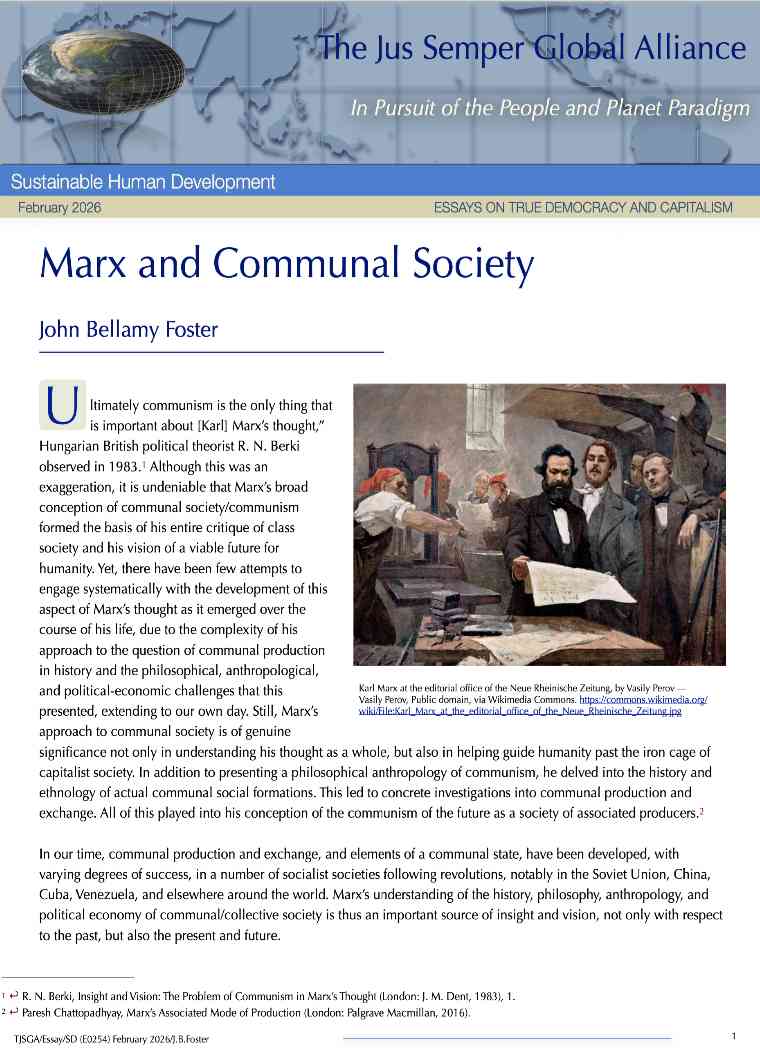
Ultimately communism is the only thing that is important about [Karl] Marx’s thought,” Hungarian British political theorist R. N. Berki observed in 1983. Although this was an exaggeration, it is undeniable that Marx’s broad conception of communal society/communism formed the basis of his entire critique of class society and his vision of a viable future for humanity. Yet, there have been few attempts to engage systematically with the development of this aspect of Marx’s thought as it emerged over the course of his life, due to the complexity of his approach to the question of communal production in history and the philosophical, anthropological, and political-economic challenges that thispresented, extending to our own day. Still, Marx’sapproach to communal society is of genuine significance not only in understanding his thought as a whole, but also in helping guide humanity past the iron cage of capitalist society. In addition to presenting a philosophical anthropology of communism, he delved into the history and ethnology of actual communal social formations. This led to concrete investigations into communal production and exchange. All of this played into his conception of the communism of the future as a society of associated producers.
In our time, communal production and exchange, and elements of a communal state, have been developed, with varying degrees of success, in a number of socialist societies following revolutions, notably in the Soviet Union, China, Cuba, Venezuela, and elsewhere around the world. Marx’s understanding of the history, philosophy, anthropology, and political economy of communal/collective society is thus an important source of insight and vision, not only with respect to the past, but also the present and future. For a full read of this brief, click here or on the picture to download the pdf file. |